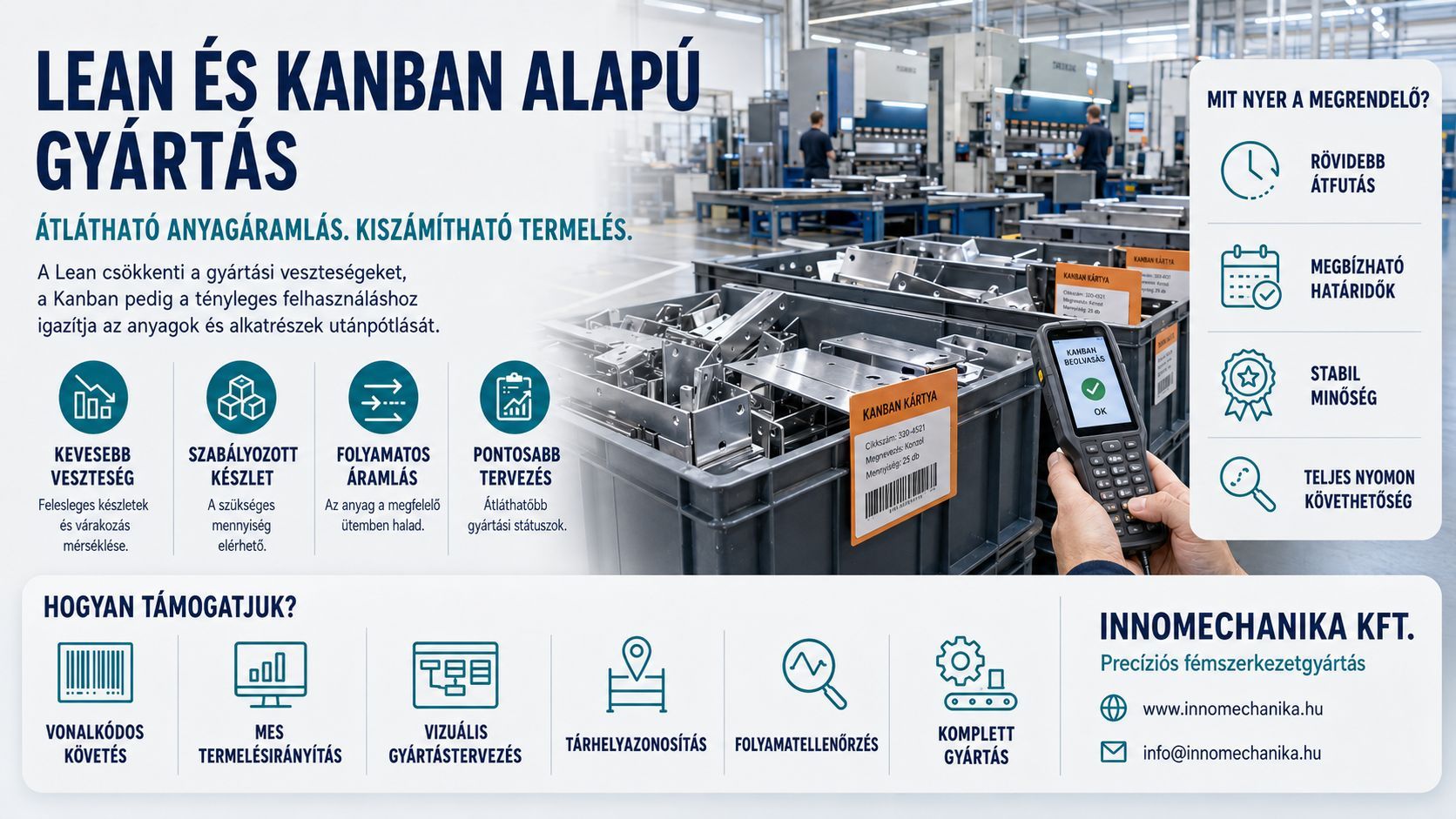
The effectiveness of modern production is not only determined by the performance of the machines. A high-precision laser cutting system, a modern bending machine or a robotic welding cell can only be used efficiently if the necessary raw materials, components, documentation and production information are available at the right time. The path of the material is therefore just as important a part of production as the machining itself. The Lean approach and the Kanban system help to make this path more transparent, regulated and predictable. The goal is to reduce unnecessary waiting, moving and inventory, to harmonize production processes and to meet deadlines more reliably. This is especially important in precision metal structure manufacturing, where many product variants, different sequences of operations and strict quality requirements come together.
What is Lean?
Lean is a corporate governance and process improvement approach, which starts with the value created for the customer. It seeks to find out which parts of each workflow contribute directly to the creation of the right product, quality and delivery performance, as well as where time, capacity or material is wasted. The roots of this approach are linked to Toyota’s production system. Over time, its principles have spread beyond the automotive industry, as process transparency, consistent quality and continuous improvement are valued in almost all production environments. Lean is not a single method or software that can be implemented. It involves a sequential mindset, management practice, and concrete operational tools . According to the Lean approach, the entire value stream must be examined from the receipt of the order, through the procurement of raw materials and production operations, to the delivery of the finished product. The spectacular acceleration of a sub-process alone can bring little result if the finished parts then wait for days before the next operation. The same is true in the case when an excessive stock of semi-finished products develops around it during the high utilization of a machine. Lean therefore focuses on the flow of the entire process. It examines waiting, overproduction, unnecessary material handling, unnecessary inventories, repair due to errors, unjustified operations and the utilization of available human knowledge. The goal of the development is to create a more stable system that can provide adequate quality with less losses and shorter lead times. Closely related to this is the kaizen, i.e. the principle of continuous improvement. Improving a production system is rarely the result of a single major change. Often, a better layout of workplaces, standardized material transfer, more accurate marking, or a sequence of operations that is modified based on employee experience bring lasting improvement. In a Lean culture, making problems visible creates opportunities for learning and prevention.
What is Kanban?
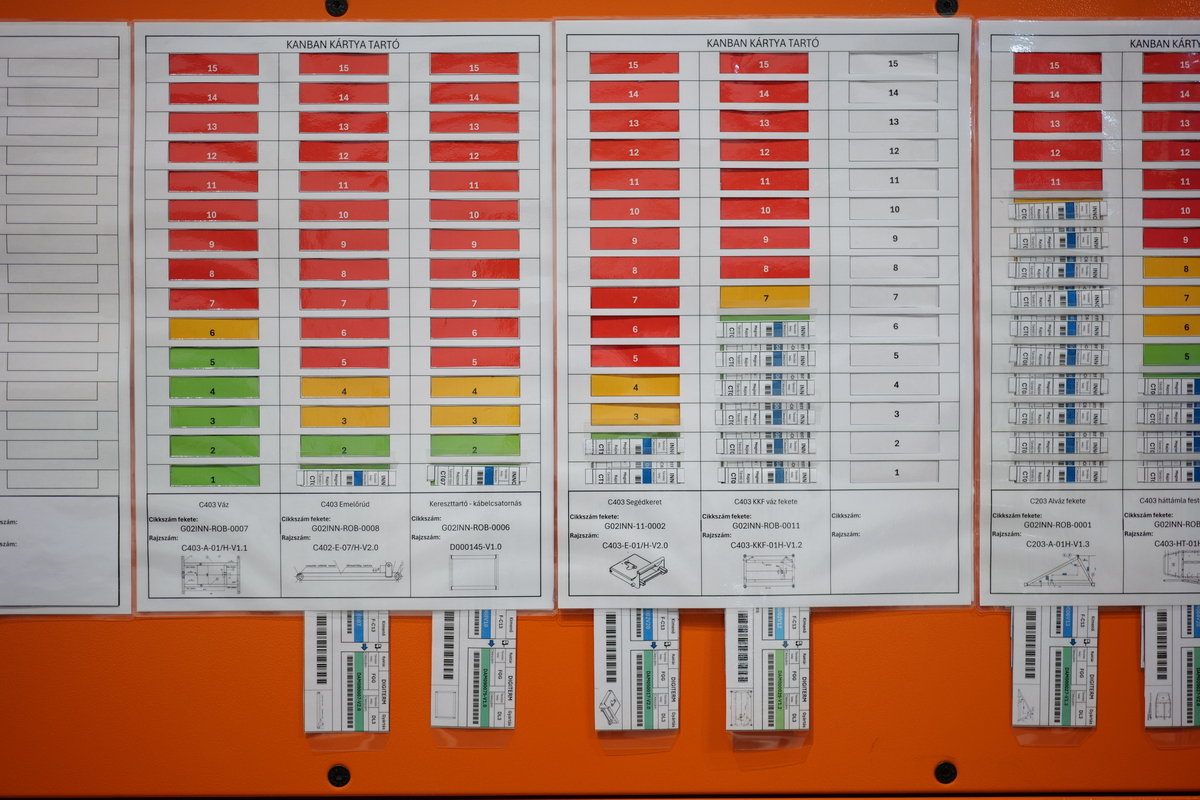
Kanban is a term of Japanese origin and means a signpost or sign. In manufacturing, it means an information and inventory control tool that authorizes the production, replenishment, or transmission of a specified quantity. The signal can come from a traditional card, a marked storage box, a barcode, or a digital system. Kanban supports the practical operation of the pulling principle. The next work phase indicates to the previous one what material or part is needed, in what quantities and when. Replenishment is started based on actual use. This way, the process is less dependent on large quantities of prefabrication and it is easier to control the inventory that accumulates between operations. A Kanban signal must carry clear information. It can include the name and ID of the part, the quantity that can be placed in a container, the place of use, the source of the replenishment and the storage position. The return of the signal shows the supply process that the given quantity has been used and therefore needs to be replaced. The production Kanban conveys a production order, and the take-away Kanban allows the material to be transferred. The coordinated operation of the two ensures that movement and production within the plant are adapted to the real demand. The system also sets a limit on the ongoing inventory. It determines how many containers or quantities can be in the system at the same time, so congestion becomes quickly visible. The effectiveness of Kanban depends on consistent compliance with the rules. If production starts without a signal, quantities are inaccurate, or cards are returned late, inventory information loses its reliability. A visual board alone does not create a pulling system. Stable processes, clear responsibilities, appropriately defined inventory levels and disciplined data management are also required.
How are Lean and Kanban connected?
Lean provides a framework for the development of the entire operation, and Kanban is one of the practical tools for this. Lean sets the direction: increasing customer value, reducing losses, improving flow and continuous learning. Kanban makes the movement of material and related information controllable. The connection between the two approaches becomes particularly visible in the pull principle. When a process only replaces what was actually used by the next operation, the risk of overproduction is reduced. The inventory level becomes more controlled, and deviations are revealed sooner. For example, if all Kanban containers are full before a work phase, this indicates that the material cannot proceed at the right pace. This can be due to a lack of capacity, machine downtime, a quality problem, a long changeover or an inaccurate production order. The system thus also plays a diagnostic role. Excess inventory often masks production problems because it can supply a stuttering process for a longer period of time. A regulated inventory level indicates an imbalance sooner and therefore allows for faster intervention. Long-term results are achieved by identifying the causes, improving the process and establishing the appropriate standard.
The importance of material flow in metal structure manufacturing
Precision Metal Structure Manufacturing complex value stream. After receiving and identifying the raw material, laser cutting, bending, machining, welding, grinding, surface treatment, assembly and final inspection can follow. The technical content of the product determines the actual route, while each production batch can travel at different speeds. In this environment, it can cause serious losses if a part is made too early and then has to be stored for a long time. Unnecessary handling increases the risk of damage, mixing and identification errors. At the same time, a delayed delivery of raw material or fastener can prevent the completion of a complete assembly. In this case, a significant part of the value of the product has already been completed, but the shipment cannot be started. Lean-based material flow Therefore, it starts with aligning routes, handover points, storage rules, and required inventory. Mapping the value stream shows the entire path of material and information from order to delivery. Actual machining time, waiting between operations, recycling, unnecessary shipping, and any point where the process loses continuity become visible. The goal is not to eliminate inventories at all costs. A properly sized buffer can compensate for different cycle times, ensure the supply of critical jobs, and handle reasonable fluctuations in supply. Too much inventory ties up capital and takes up space, and too little inventory makes the system sensitive. When determining the right quantity, you need to consider the rate of depletion, replenishment time, delivery frequency, risk of scrap, and changes in demand.
Where can Kanban be applied in custom and series production environments?
Kanban is easiest to operate for materials and components whose use is repetitive and measurable. These can be standard fasteners, frequently used auxiliary materials, packaging materials, consumables or regularly manufactured components. In the case of a two-storage system, the use of one inventory provides the supply signal, while the other storage provides supply during the purchase or production period. In production that handles a large range of products and small series, differentiated control is required. It would be uneconomical to maintain a constant stock of unique, high-value or rarely repeated parts. Their movement should be controlled based on order-based production orders, sequence of operations and identified production units. Inventory between operations can be limited by a FIFO bar or a specific number of waiting locations. The first batch to arrive will then proceed first, and the upper limit of the inventory will remain clear. In practice, therefore, a hybrid system often gives good results. Recurring items with high turnover rates can be replaced using Kanban, and individual products can be tracked based on a digital production order. This allows you to maintain flexibility and process control at the same time.
Material flow and information flow can be developed together
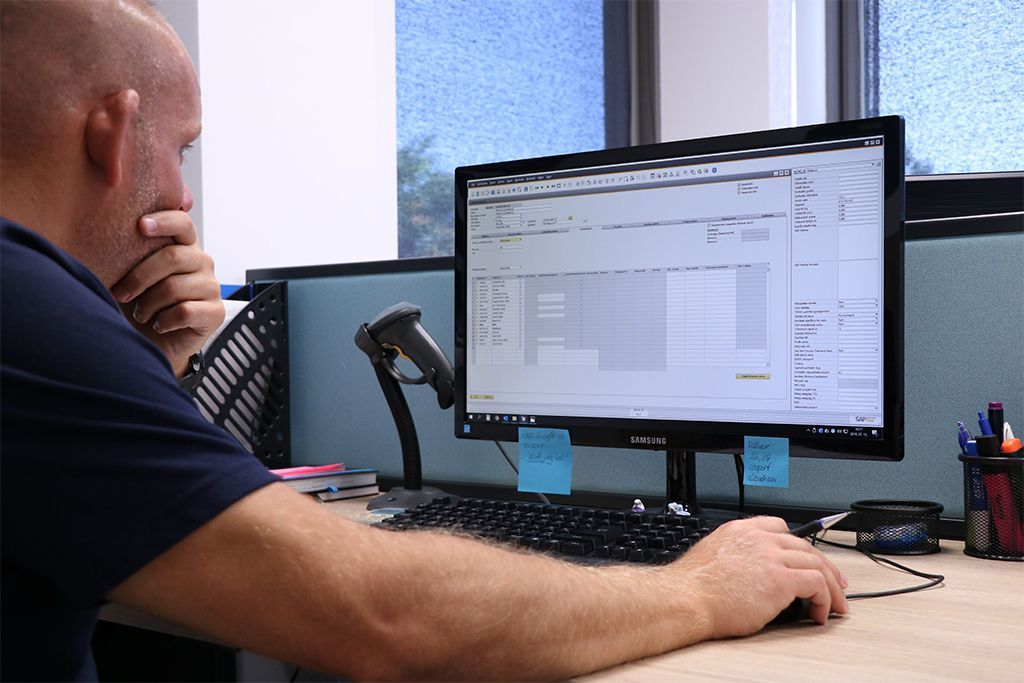
The material moving in the production hall must be accompanied by accurate, up-to-date information. It is necessary to know which order the given item belongs to, what operations it has undergone, where it is located, what inspection status it is in, and when it needs to be forwarded to the next workplace. In addition to incorrect or delayed recorded data, a physically well-organized process also becomes uncertain. Digital production management and visual plant control reinforce each other. The ERP system manages order, inventory management and company-level data, as well as MES and provide a detailed picture of how production is being carried out. Barcode identification, workstation reporting and storage tracking reduce the uncertainty of manual information transfer. Kanban signals can also be integrated into this environment as an electronic supply requirement. The production management of Innomechanika Kft. is supported by an SAP Business One ERP module, an integrated MES Pharis production management system and a visual production planner. Storage space identification, barcode product tracking, electronic reporting per workstation and the integration of data from production machines provide a real-time view of processes. The analysis of historical production data also provides a more secure basis for the planning and development of repetitive jobs.
The impact of balanced production organization on quality
Hasteries, overloaded workplaces and unorganised intermediate stocks create quality risks. A mixed part, a missed inspection or a damaged surface can lead to costly repairs and delays in the future. A controlled flow clarifies the status of the material, the conditions for delivery and the responsibility for the next operation. Quality must be ensured in the individual processes. If a discrepancy occurs, the affected batch must be identified and isolated, and then it must be prevented from receiving additional added value in a defective state. A problem detected in time affects a smaller quantity, can be traced more quickly, and the root cause is easier to identify. Balanced production also has a positive effect on human work. Constant urgency, unexpected changes in priorities and material search reduce attention. Clear order, an orderly workplace and available information create a more predictable working environment in which more attention is paid to technical details and quality.
What does the industrial customer perceive from all this?
For the customer, the value of Lean and Kanban-based operation is reflected in delivery performance, flexibility and consistent quality. Transparent capacity and inventory levels allow for more accurate feedback on the commitment deadline. A regulated production sequence reduces congestion and the number of unfinished items. And traceable material movement supports documented, retrievable production. This is especially important in a long-term supplier relationship. The partner needs the manufacturer to keep the process under control even with changing order quantities, multiple product variants and complex technical requirements. This is when the advanced machinery is connected to organizational knowledge and data-driven production management. A well-functioning system also helps to manage changes. The impact of an urgent order, a modified delivery schedule or a supplier deviation can be assessed more quickly if the ongoing inventory, the workload of workplaces and the status of individual production batches are known. This way, the decision can be based on real data and is less likely to cause another disruption at other points in production.
Lean adoption is a consistent development process
The effective application of Lean and Kanban requires an accurate assessment of the situation. First, you need to understand the actual process: how the demand arrives, where the material moves, where inventory is generated, how long each operation takes, and at which points there are regular waits or recurring errors. This can be the basis for the desired future state and the timing of implementation. A common mistake is when the inventory level is reduced before the process is stabilized. Without reliable supply, adequate machine availability, known cycle times and consistent quality, a buffer that is too tight can cause production losses. The same risk is created if Kanban quantities are determined once and then not reviewed despite changes in demand or replenishment times. Measurable goals are needed for development. Lead times, on-progress inventory, on-time order completion rates, internal material handling, downtime and quality variations all add up to how the system performs. In addition to numbers, the experience of plant workers is also essential, as they are the first to detect hard-to-reach materials, uncertain signals, and disruptions that occur every day.
Efficient material flow for reliable production
The common value of the Lean approach and the Kanban system is transparency. With their help, it is possible to see more accurately what is happening to the material, what triggers the next operation, where congestion occurs, and what is the reason for continuous progress. The process made visible can be developed in a targeted manner. In modern metal structure manufacturing, technological precision and organizational discipline reinforce each other. The right material reaches the right workplace at the right time, while the production information follows the product throughout. This lays the foundation for shorter and more predictable turnarounds, less unnecessary inventory, better capacity utilization and more stable quality.
The modern production technologies of Innomechanika Kft. are complemented by integrated production management and monitoring solutions. The harmonization of complex production processes makes it possible to produce individual and serial parts, welded structures and Mechatronic Components Its production should be carried out in a transparent, controllable system. Contact us about your industrial project and we can discuss the technical, quality and delivery requirements.