In the world of modern sheet metal processing, bending It has long since ceased to be a mere shaping operation. In today’s manufacturing environment, the accuracy, repeatability, speed and documentability of bending have a direct impact on the success of the entire project. An incorrectly chosen technology or a lower-level machine can hinder the entire production chain, while a modern, high-performance bending system provides a stable basis for quality series production. A TruBend 5130 One of the most balanced solutions in this category. Not because of marketing promises, but because its design, control and built-in measurement systems prove themselves in a real industrial environment day after day. With a pressing force of 130 tons and a bending length of more than three meters, this machine offers a universal platform that is ideal for the production of most industrial sheet metal parts. In this article, we will explain in detail what the TruBend 5130 means in practice, what jobs we use it for and what clients gain from it in everyday production.
Basics and construction of the machine
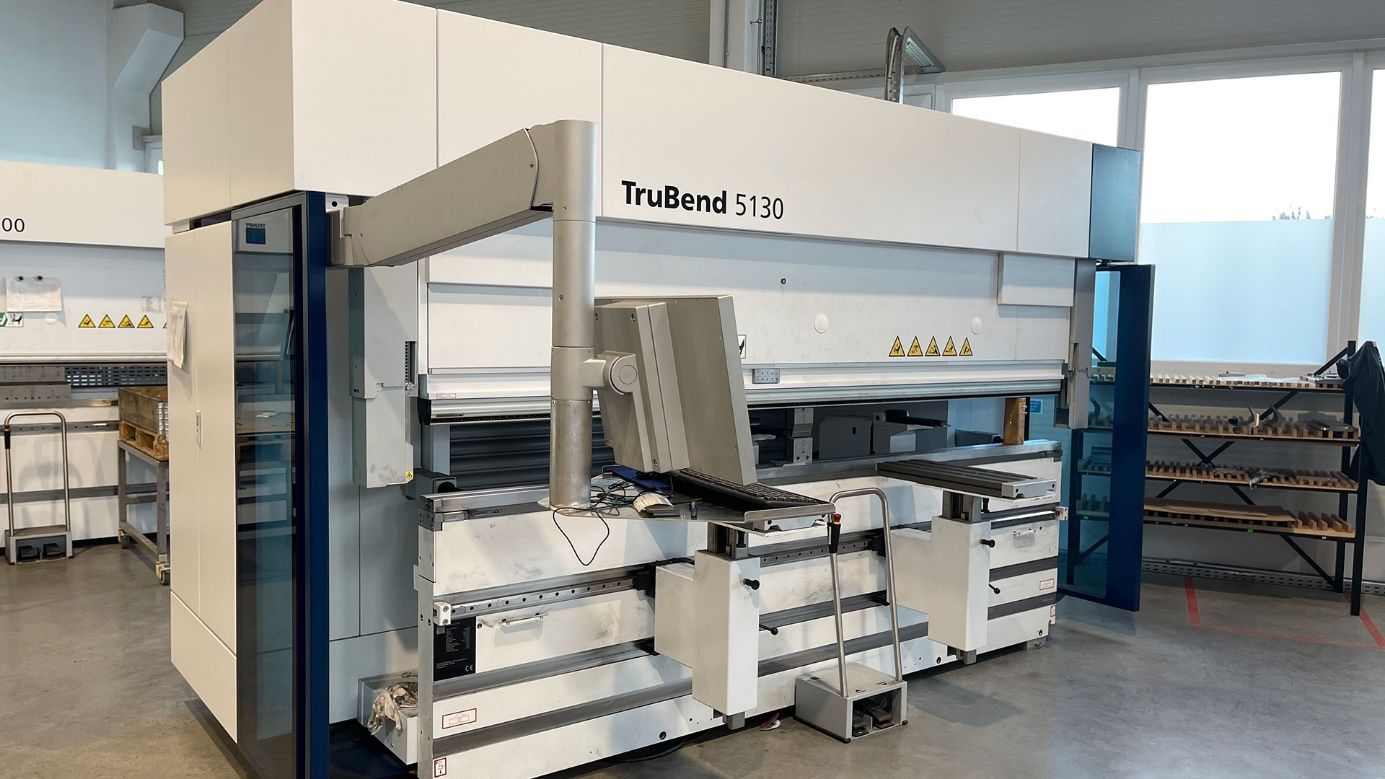
The TruBend 5130 is a CNC controlled hydraulic bending machine which is specially designed for industrial precision and heavy use. The nominal pressing force of 130 tons allows the bending of thicker structural steel plates, while the bending length of 3230 millimeters is sufficient for the production of most cladding and structural elements. The machine’s sturdy frame and precision guiding system minimize deflection and structural deformation under load. This is not just a mechanical detail, but also has a direct impact on the accuracy of the finished part. The forces that occur during bending put a strain not only on the workpiece, but also on the machine itself. If the machine frame is not sufficiently rigid, the bending angle may vary along the entire length. The construction of the TruBend 5130 minimizes this risk. The multi-axis rear stop system ensures precise plate positioning. CNC control not only controls the amount of deflection, but also coordinates the entire bending process, including axis movements, material thickness compensation, and angle correction.
Accuracy and repeatability in industrial environments
From edge bending One of its biggest challenges is material variability. Even with the same nominal material thickness, the yield strength, hardness or modulus of elasticity may differ. These deviations affect the springback, i.e. the extent to which the angle changes after bending. One of the key advantages of the TruBend 5130 is the automatic angle measurement and correction system. Built-in sensors measure the angle in real time during bending, and the control immediately corrects if there is a deviation from the prescribed value. This means that the machine not only executes the program, but actively reacts to the behavior of the material. This is a tangible advantage for the client. Tight tolerance fields can be maintained, subsequent alignments and mounting problems are reduced, and scrap rates can be minimized. In the case of a larger series, this results in a difference that can be measured not in percentages, but in specific costs.
What jobs is the TruBend 5130 ideal for?
It can be widely used due to the universality of the machine. The most common areas of application include the production of industrial enclosures, electrical cabinets, machine frame elements, brackets, supporting structures and various box structures. In the case of medium-thickness structural steel, it gives a stable and reproducible result. When bending stainless steel , high precision is especially important, as the material is more aesthetically and functionally sensitive. For aluminum Flexibility and springback management are critical, which is effectively supported by the machine’s intelligent correction system. In the production of complex parts with multiple bends, precise shaft positioning and a programmable stop system enable quick changeover and repeatable production. A part that requires five or six consecutive bends in different directions can be made on this machine in a structured, pre-programmed order.
Serial production and small series economics
In a manufacturing environment, there are often two different needs. One is the continuous production of large series, and the other is the rapid servicing of smaller, flexibly changing series. The TruBend 5130 is competitive in both areas. For large series After programming and tool adjustment, the machine works with a stable, consistent cycle time. Due to the automated angle correction, there is no need for constant manual checking. The operator’s job is to supervise the process rather than make corrections. For small series Rapid changeover is the key factor. The CNC control stores the programs, so there is no need for re-experimentation when reordering a previously manufactured part. This significantly reduces the preparation time and the risk of error of the first piece. For the client, this means shorter lead times and more predictable deadlines.
Quality assurance and documentability
In today’s industrial projects, documented production parameters are often an expectation. The TruBend 5130 has a control system capable of recording and retrieving bending data. This is especially important in industries where auditable processes are required. If a part is remanufactured years later, the previous parameters can be reloaded. The bending angle, material thickness, tool combination and axis positions can be reproduced from data, not from memory. This type of control not only increases quality, but also reduces the possibility of deviations due to human error.
What does the client gain from using the TruBend 5130?
The most important advantages are accuracy and repeatability. A mountable part works well if the bending angles and dimensions consistently match the drawing. A stable bending result means fewer subsequent joining problems. A The second significant advantage is cost-effectiveness. Lower scrap rates, shorter set-up times and faster cycle times all contribute to optimal unit costs. This is not necessarily reflected in the hourly rate, but in the cost of the entire project. The third factor is flexibility. The machine is suitable for the simultaneous handling of prototypes and serial production. A project can start with a small amount and then grow into a large series without having to change technology.
Practical experience and industrial reality
The capabilities of the machine alone are not enough if there is no appropriate professional background behind it. The TruBend 5130 shows its true power when programming, tool selection and material knowledge are in harmony. The choice of bending radius, the geometry of the tool and the quality of the material all affect the end result. The modern CNC system supports the decisions, but the manufacturing experience gives the ultimate stability. For the client, this means that the part is not just a high-performance machine, but a controlled, predictable production process.
How do we help our clients based on TruBend’s 5130 technology?
The capabilities of the TruBend 5130 are a major technical advantage in themselves, but the real value for the client is realized when bending is not carried out as a stand-alone operation, but as part of a well-thought-out, integrated production system. Our company works with this approach. The goal is not only to bend a sheet metal to an exact angle, but to make the entire production process stable, predictable and economical.
The TruBend 5130’s high-precision bending system supported by automated angle correction allows us to comply with drawing specifications from the very first piece. We complement this technological base with well-thought-out preparation and production organization. A Laser Cut Parts Its geometry is optimized for bending needs, taking into account the quality of the material, flexibility characteristics and the bending order. As a result, bending is not a series of corrections, but a controlled, repeatable process.
For our customers, this primarily means security. Tight tolerances can be maintained, parts can be interchanged during series production, and assembly time is reduced. The proportion of scrap generated during production is low, because the capabilities of the machine are used with proper professional preparation. This is a direct cost advantage, especially for larger series.
Another important advantage is the integrated production background. For us, bending is not a separate service, but a complex Sheet metal processing chain . Cutting, bending, welding, surface treatment and, where applicable, assembly are carried out in a coordinated system. This means shorter lead times and fewer coordination tasks for the client. There is no need to coordinate between several subcontractors, responsibility and quality assurance remain in one hand.
The programmability of the TruBend 5130 allows for the rapid reproduction of returning products. The production parameters can be saved and reproduced, so that in the case of a previously proven design, the process does not start with experimentation. This is especially important for partners who regularly order the same or similar parts and expect consistent quality.
We also provide flexibility. The machine is suitable for the production of prototypes and smaller series, as well as for servicing larger volume orders. A development project can start with a few pieces and then develop into serial production without the need for a technological change. This reduces development risk and accelerates time to market.
We also provide technical support during the design phase. Optimization of bendability, proper edge design, inner radius and bending order can result in significant cost savings already at the drawing level. Based on our experience, in many cases, small geometric modifications are enough to make the part more economical and stable to manufacture. With this, the client gets not only a manufacturer, but also a professional partner.
Our professional closing thoughts
The TruBend 5130 is not just another 130-tonne bending machine. An industrial tool that balances accuracy, repeatability and economy. Suitable for complex, for the production of multi-bending parts, It provides a stable solution for medium to large series, while remaining flexible to serve smaller projects. The greatest value for clients is that bending is not an experimental process, but a controlled technology. Stable angle values, documented parameters and a low scrap rate all contribute to ensuring that the finished parts fit precisely into the entire structure. In today’s competitive environment, production accuracy and deadline reliability are basic expectations. The TruBend 5130 provides a solid technological background for this.