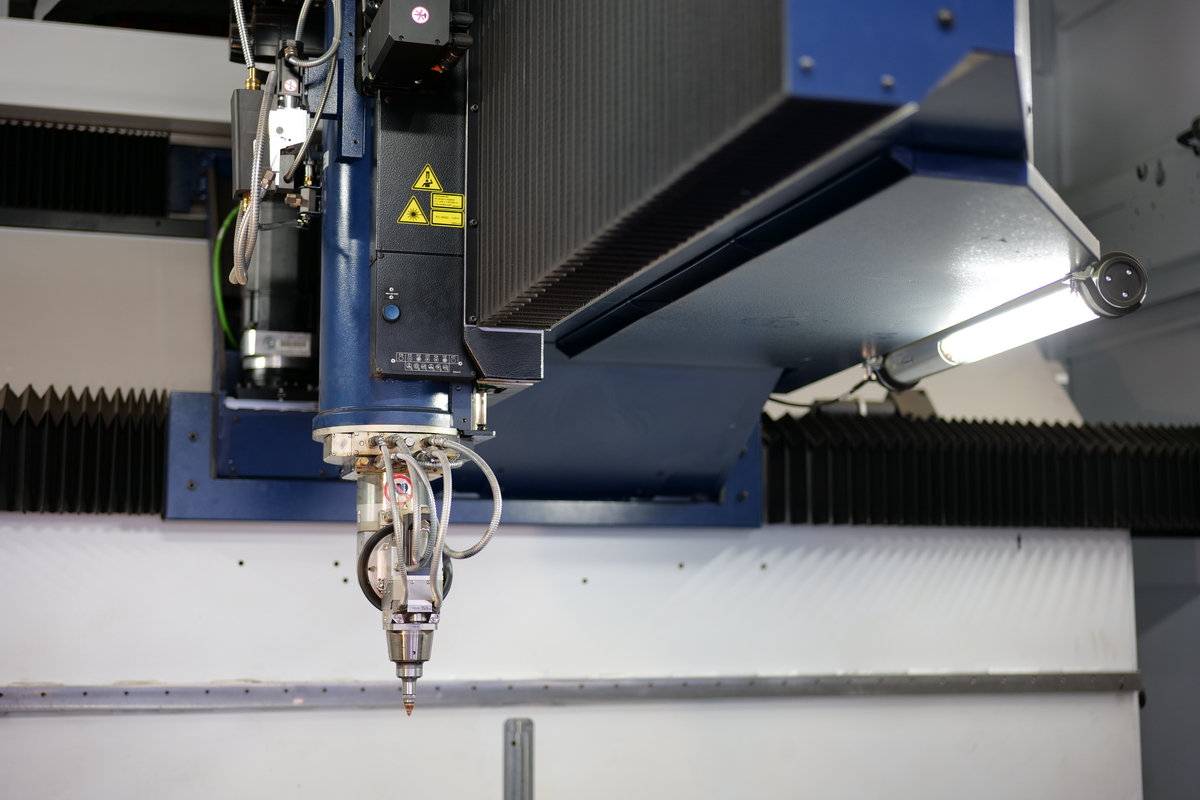
When you think of laser cutting, many people think of a flat plate from which the machine quickly and accurately cuts out the shape specified in the technical drawing. This is the perfect solution for the production of many parts. However, the situation changes when it comes to creating a precise contour, opening or connection point on a workpiece that has already been bent, deep-drawn, pressed or otherwise preformed. In this case, the machining must follow the spatial geometry of the part. 3D laser cutting is designed for complex tasks. It allows the machining of parts whose surface changes in several directions, so the position and angle of inclination of the cutting head must be constantly adapted to the workpiece. The decision to use the technology should always be made based on the geometry, the expected accuracy, the size of the series and the subsequent assembly requirements.
What exactly does three-dimensional laser cutting mean?
When cutting a flat sheet, the workpiece is placed on a horizontal surface, and the laser beam typically processes perpendicular to the plane of the sheet. The cutting path varies in length and width, while the surface position of the material remains essentially constant. A Three-dimensional laser cutting The machine follows the shape of the part in space. The cutting head can move along several axes and its angle of inclination can also change during machining. This allows precise contours to be created on curved, inclined, staggered or other complex surfaces. The workpiece is clamped in a properly designed device. The machine then follows the programmed path based on the digital model, while also controlling the distance between the cutting head and the part as well as the direction of incidence of the laser beam. Therefore, the success of the process depends not only on the capabilities of the machine, but also on the accuracy of programming, instrumentation and the position of the part.
When is there not enough traditional flat laser cutting?
2D laser cutting It is ideal when the part is still a flat sheet at the time of cutting. The necessary external contours, holes and cutouts can then be made quickly. The cut-out sheet can then be bent, welded or further machined. For some parts, however, the position of the final openings can only be determined with sufficient certainty after forming. During bending, pressing or deep drawing, the shape and size of the material may change slightly. If all cut-outs were still made in a flat state, the holes could be moved, the contours could be distorted or the position of the connection points could be different after subsequent forming. 3D laser cutting allows the final geometry to be formed after pre-forming. This allows holes, windows, mounting holes and external contours to be made directly on the part that has already taken on a three-dimensional shape.
Machining of preformed and deep-drawn sheet metal parts
Deep drawing and stamping can be used to produce rigid, lightweight sheet metal parts with complex shapes. These are widely used in the automotive industry, mechanical engineering, electronic equipment and various casing systems. After forming, it is often necessary to cut the flanges to the exact size. In addition, fastening holes, cable passages, ventilation holes or connection points must also be created. In many cases, the position of these affects several different surfaces and is therefore no longer accessible on a conventional flat laser machine. The 3D laser cutting equipment follows the spatial contour to cut around and create the necessary openings.
Post-processing of bent parts
On a bent sheet metal part, there may be openings that touch several planes or are located close to the bending line. Pre-cutting the holes can be risky in this case, as bending can cause them to change shape and position. With the help of subsequent 3D laser cutting, the required contour can be adjusted to the actual spatial position of the part that has already been bent. This is especially important if the part needs to be precisely connected to other elements or the opening is part of a sensitive mounting point. The method is also well suited for complex machine enclosures, equipment housings, brackets and mechatronic components. Precisely designed connection locations facilitate assembly and reduce the chance of the part having to be manually aligned during assembly.
Spatial machining of pipes and profiles
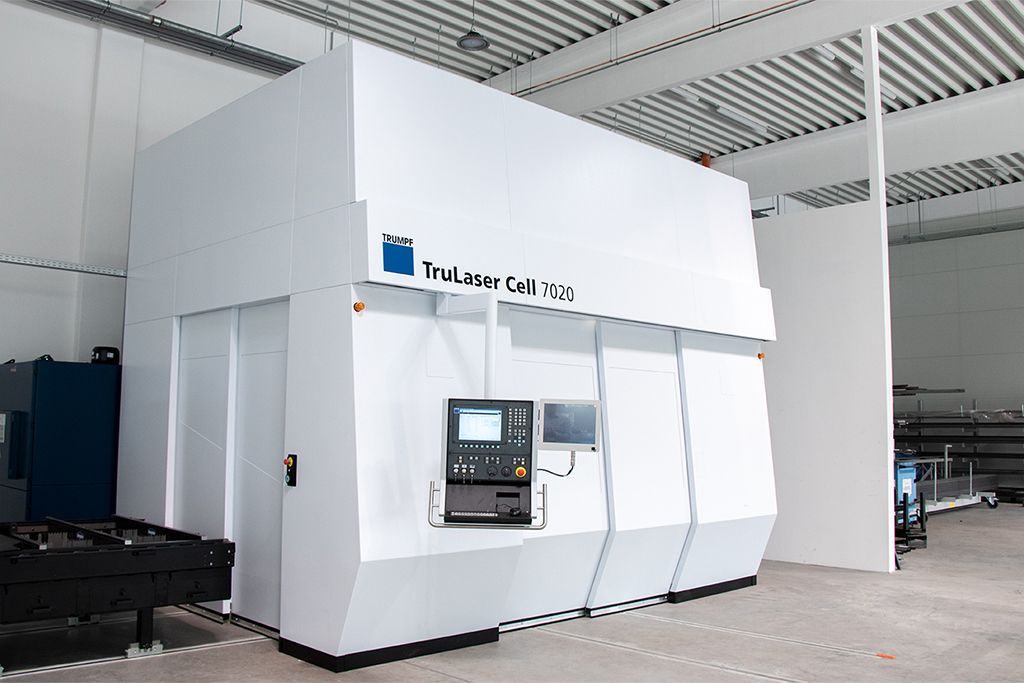
Holes, notches and connector contours in the casing of pipes and hollow sections are also a spatial task. The cutting head must follow the surface of the circle or other cross-section, while the laser beam reaches the material in the right direction. A With 3D laser cutting Connection forms can also be created that facilitate subsequent joining and welding. A well-designed contour allows the pipe or profile to sit precisely on the related component. This improves assembly, makes the joint gap smoother, and makes the welding process more predictable. The technology can be used for pipe or profile components of machine frames, supporting structures, furniture components, protective frames and various equipment. Used by Innomechanika The TruLaser Cell 7020 can be used for laser cutting and laser welding of two- and three-dimensional components as well as pipes.
Subsequent cutting of complex welded structures
For some parts, precise machining becomes necessary after the welding process. As a result of the heat input, a small amount of deformation can occur, which affects the final dimensions of the structure. If a hole or connection contour needs to be in a precise position in relation to the finished structure, it may be justified to redesign it. If there is sufficient accessibility, 3D laser cutting can also be applied to certain surfaces of the already assembled spatial structure. In this case, it is particularly important to have a stable fixation, to define clear reference surfaces and to design a collision-free tool path. In all cases, the decision must be preceded by a manufacturability test. The size of the structure, the accessibility of the cutting point, the thickness of the material and the safe removal of the cut material must also be taken into account.
Why should you cut after final formatting?
During sheet metal forming, the material is stretched, compressed, and then springs back to a certain extent after the load is released. The resulting deviation is influenced by the properties of the raw material, sheet thickness, bending radius, tooling and the applied technological parameters. As a result, the actual part geometry may differ slightly from the nominal model. When choosing the production order, it is therefore necessary to consider the impact of the forming on critical holes, openings and connection points. Less sensitive contours can often be made in a flat state, while details tied to the final part position should be formed after bending or deep drawing. The correct sequence of operations reduces the need for subsequent corrections and can ensure a more accurate fit during subsequent assembly.
Prototype and small series production
When a new part is developed, the location of the holes, the outer contour or some connection detail often changes. When using a mechanical cutting tool, any major modification may require a tool modification or the creation of a new tool. This can be time-consuming and expensive.
The laser is a programmable machining tool. A significant part of the geometric changes can be tracked by modifying the digital model and the machining program. Therefore, 3D laser cutting can be particularly advantageous for prototypes, pre-series and small or medium series. The technology can shorten the product development cycle, because the modified part can be manufactured without the need for a new mechanical cutting tool. The refinement of the design can thus follow the experience of testing and assembly tests more quickly. 3D laser cutting may also be justified for large series, especially with complex geometries and a high degree of automation. However, in order to assess the economy, the total cycle time, equipment, machine utilization and the tool costs of alternative technologies must be examined together.
How can you reduce the amount of post-production?
In conventional manufacturing, a three-dimensional part can go through several separate operations. Cut-around, hole-making, milling, and certain manual corrections can be made separately. Each new clamping takes time and creates the possibility of new positioning deviations. 3D laser cutting can allow multiple contours and openings to be created in a single clamping. The position of the workpiece remains constant, and the cutting head reaches the programmed points relative to the same coordinate system. This can improve the positional accuracy of the holes and cutouts that belong to each other. A Laser Cutting It is a non-contact process, so that the cutting tool does not exert mechanical force on the part in the traditional sense. This can be particularly valuable in thin-walled or sensitive structures. A cutting edge with the right parameters can also reduce the need for deburring and subsequent manual processing.
What does the accuracy of 3D laser cutting depend on?
A modern machine creates an important foundation, but it does not guarantee the right end result in itself. Accuracy depends on the coordination of the entire production process. The geometric consistency of the initial parts is a decisive factor. If there is a significant difference in size between the pressed or bent workpieces, the same program may meet the surface in different places. The design of the device, the position of the support and orientation points, as well as the repeatable clamping of the workpiece play an important role. During programming, the trajectory of the cutting head, its direction, the approach method and the order of the individual contours must be determined. The thermal effect, the behavior of the cut parts and the possible collision risks must also be taken into account.
Material quality, wall thickness, surface condition, cutting speed, laser power and process gas also have an impact on the cutting edge. Reliable series production is therefore preceded by the production of sample pieces, measurement checks and, if necessary, parameter correction.
Is 3D laser cutting required for all spatial parts?
The use of the technology is justified if it creates a measurable production or quality advantage. In the case of a simple part, it is often more economical to cut out the contours in a flat state and then bend it. For high-precision parts that require a machined surface, milling or other cutting processes may be more suitable. Laser cutting has a thermal effect and therefore requires a separate technological test for sensitive materials, special surface requirements or very large wall thicknesses. The accessibility of the geometry is also decisive. The cutting head must reach the machining area safely, while leaving enough space between the machine, the device and the component. The basis for a good decision is the examination of the entire production process. In addition to the unit price, the tool cost, preparation time, number of fixtures, post-processing, the risk of scrap and the possibility of subsequent design modifications must be taken into account.
The place of 3D laser cutting in complex metal structure manufacturing
Three-dimensional laser cutting is at its best when it is organically integrated into the rest of the production process. Flat laser cutting, CNC bending, welding, grinding, surface treatment and assembly coordination have a fundamental impact on the quality of the finished structure. The TruLaser Cell 7020 provides a flexible production environment in which two- and three-dimensional components as well as pipes can be laser cut and laser welded. This is particularly valuable for complex projects that require multiple operations, where final accuracy is achieved by the interplay of individual production steps.
The need for 3D laser cutting is ultimately determined by the geometry and purpose of the component. For preformed sheet metal parts, bent elements, pipes, profiles and spatial structures, it enables contours to be created that would no longer be possible with sufficient precision in the plane. The technology can reduce equipment and tool costs, reduce the number of fixtures, speed up product modifications and make assembly more predictable.
However, the real advantage always comes from the right technical decision. To do this, it is worth examining the part from the point of view of manufacturability at an early stage of the design. This way, it is possible to determine exactly which details should be made with a flat laser, which should be created after forming, and where 3D laser cutting offers a real economic and quality advantage.
What data are required for the request for quotation?
To obtain an accurate technical offer, the first thing you need is a three-dimensional CAD model of the right quality. In addition, it is important to have a dimensioned technical drawing, which includes tolerances, critical dimensions and surface requirements. The type and thickness of the raw material and the number of pieces to be produced must also be specified. Important information is the condition in which the workpiece arrives for 3D laser cutting. Other equipment may be required for a pressed sheet metal part, a bent element, a pipe or a structure that has already been partially welded. The manufacturer must also know what other operations follow the cutting, such as welding, grinding, surface treatment or mechatronic assembly. Clearly marking the critical characteristics helps to ensure that the technological design is really adapted to the operation of the finished product. For example, the position of an assembly hole may be more important than a tenth of a millimetre deviation from a less visible outer edge. Such differences also affect the measurement plan and the production cost.
How can we help?
Innomechanika Kft. provides a comprehensive manufacturing background from the manufacturability testing of three-dimensional parts to the production of finished components. With the TruLaser Cell 7020 equipment, we can perform precision laser cutting and laser welding of two- and three-dimensional parts and pipes.
Already during the technical preparation, we examine the geometry of the part, the access of the cutting head, the necessary equipment and the expected tolerances. We help to determine which contours should be formed in a flat state and for which details 3D laser cutting after bending, pressing or other forming operations is justified.
Laser cutting is supplemented with CNC bending, welding, grinding, surface treatment and mechatronic assembly on request. This allows us to plan sequential production operations in a coordinated manner, so that reliable quality can be achieved for prototypes, small series and regularly produced parts.
Send us the available technical documentation of the part and the planned production quantity. Our experts will examine the manufacturability of the task and make a proposal for a technically appropriate and economically feasible production process.