In the world of metal structure manufacturing, every millimeter counts. Not only because the structure has to fit, but also because the fit determines the load-bearing capacity, durability, mountability and ultimately the satisfaction of the client. Laser cutting in this environment is not a technological buzzword, but a tool that has fundamentally transformed the way we work with metal today. Customers often see “only” that the finished part is accurate, beautiful and quickly completed. However, there is a conscious decision in the background: When, why and how to apply laser cutting in the manufacturing process. This article is for clients who want to understand what happens between the plans and the finished metal structure. It is not marketing material, but a professional explanation of a technology that is now unavoidable, but not always for its own sake.
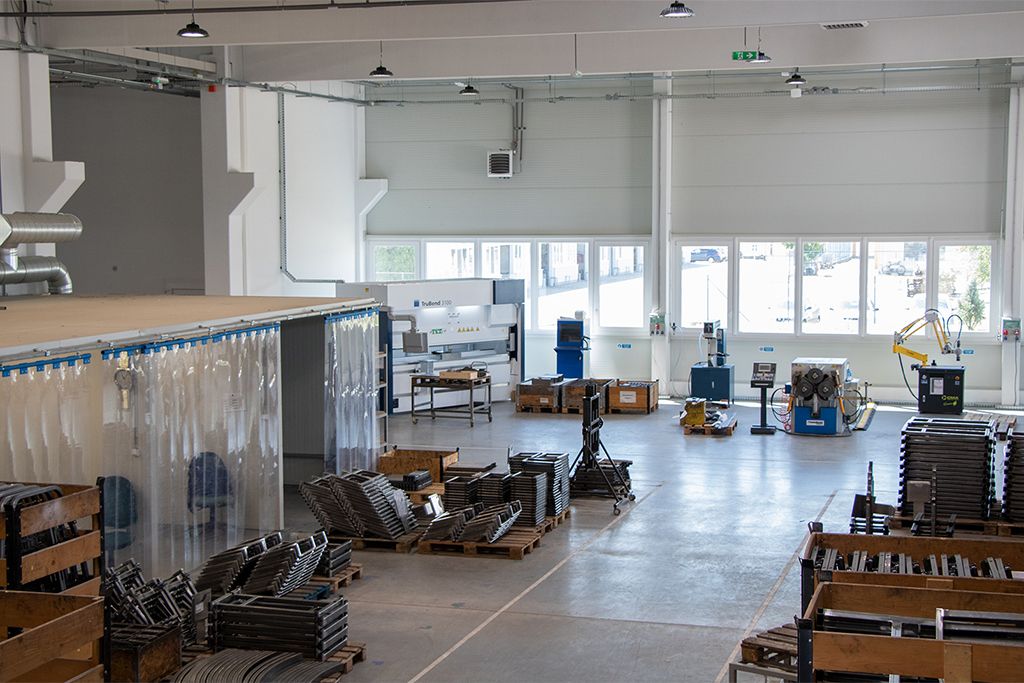
The location of laser cutting in the entire metal structure production
Laser cutting It is not a miracle weapon in its own right, but one of the defining elements of the production chain. Its role can be truly understood if we do not see it as an isolated operation, but as part of the process from design to assembly. A metal structure is always made thinking in a system. Material selection, sizing, cutting, joining, welding and surface treatment are built on each other. Laser cutting enters this system where accuracy, repeatability and material quality preservation are all requirements. Not all parts require it, but where it does, it can be replaced with other technologies or only with compromises.
What actually happens during laser cutting?
During laser cutting, a laser beam with a high energy density is concentrated on an extremely small surface. This energy melts or vaporizes the metal while an auxiliary gas removes the melt from the cutting gap. The process is controlled, computer-controlled, and takes place directly based on digital designs. In practice, this means that the geometry in the drawing is not a matter of interpretation. There is no “a little like this”, “a little like that”. What we define during the design will appear in the material exactly as it is cut. This kind of consistency is what makes laser cutting particularly suitable for the production of structural elements.
When is the use of laser cutting justified?
Laser cutting becomes truly justified when traditional cutting processes are no longer able to provide the quality, accuracy and repeatability that a given metal structure requires from a structural or assembly point of view. In such situations, it is not just a question of aesthetics, but of how well the parts fit together, how much rework they require and how they behave during subsequent loading. This is especially true in the case of complex contours, holes and cutouts, where manual or conventional machining is not only slower, but also carries a greater risk of error. The Subsequent alignment, drilling or milling consumes a disproportionate amount of time and cost, while the accuracy of the end result cannot be guaranteed. Also The decisive aspect is the number of pieces and the flexibility of production. In the case of small and medium series, laser cutting creates the opportunity to produce parts without tooling, but still with industrial precision. This is not only a cost advantage, but also significantly shortens lead times. This is especially advantageous in the case of projects where production is not completely fixed, but the designs are refined, refined, or even modified as a result of the client’s needs. In this situation, laser cutting is not an obstacle, but a supporter of the design process, as it allows for a quick response without compromising quality.
Why has laser cutting changed structural engineering?
Laser cutting One of his biggest effects lies not in the quality of the editing itself, but in the way he transformed thinking. In the past, design often adapted to production constraints. Today, more and more, manufacturing is adapting to design. This change in approach allows the structures to be more efficient, lighter and more accurate. Laser cutting reduces the amount of post-processing, makes fitting more accurate, and assembly more predictable. Together, these factors reduce not only time, but also risk. In the case of a metal structure, this is especially important, as the inaccuracy is often only revealed on site, where repairs are already costly and time-consuming.
How does laser cutting fit into the design process?
The real advantage of laser cutting is when its possibilities are taken into account during the design process. Digital design and laser cutting are closely linked. Designs are not just visual ideas, but also directly become production instructions. This also means that collaboration between the designer and the manufacturer is crucial. A well-designed part is optimal not only aesthetically, but also in terms of manufacturability. Laser cutting makes it possible to have predefined joints and weld points exactly where they are structurally justified.
The effect of accuracy on assembly and finished structure
Clients often feel the advantages of laser cutting the most in the speed of installation. When the parts fit exactly, the work on the site is not improvisation, but Assembly. This reduces the possibility of errors, increases security and makes delivery times more predictable. From a structural point of view, precise cutting results in an even load distribution. If a part is not stretched or forced into place, the structure will remain more stable in the long run. This is the level of quality that is not necessarily spectacular, but can be felt even after years.
Material use and economy
Laser cutting is not only accurate, but also material-saving. By optimizing cutting plans, waste can be reduced, which is especially important for high-value raw materials. This economy does not come from “saving” material, but from conscious arrangement. From the client’s point of view, this means that costs are more transparent and predictable. There are fewer hidden costs, less subsequent corrections. Laser cutting is not necessarily a cheaper technology in this sense, but it is more predictable.
Limitations and responsible application of laser cutting
An important professional aspect is that laser cutting is not a solution for everything. There are thicknesses, material grades and structural situations where other technologies are more effective or justified. Responsible manufacturing is not about using lasers for everything, but about applying it where it creates real added value. This is important for the client because the right decision is not always the choice of the most modern technology, but the solution that best suits the given task. The task of the professional in this is to represent this in an understandable and honest way.
What does this mean from the client’s point of view?
When a client receives a metal structure made by laser cutting, then you are actually taking the result of a well-thought-out process. Accuracy, mountability and durability are not separate advantages, but part of a system. Laser cutting in this system is a tool that allows designs not to be distorted during production. This type of quality is not always spectacular at first glance, but in the long run it determines the usability and value of the structure. The role of laser cutting is therefore not to show off technological superiority, but to ensure reliable execution.
Professional Concluding Thoughts
Laser cutting is now a natural part of metal structure production, but it is not a guarantee of quality in itself. The real value is given if we use the technology with experience, professional consideration and keeping in mind the interests of the client. A well-chosen procedure works silently. It doesn’t show, it doesn’t explain itself, it just works. For the client, this means real security. To know that behind the structure there are not only machines, but also professional decisions. Laser cutting is not a goal in this process, but a means. And that’s exactly what makes it really valuable.